Bart Santello and Psychotropic Films are nearing release of a new 'Dark Ages Series' digital film: NETHER LAND; a meditation on post-industrial and post-modern landscapes. An experimental work inspired by the COVID-19 era lock-downs and the filmmakers use of the Pentax K-S1 camera's imaging technology. Shot in bold monochrome with psychoactive sound design, NETHER LAND reflects on marginalization of the human element and the subtle dehumanizing effects of technology. (13:40-min).
digital films developed by Bart Santello and Psychotropic Films™ are discussed in this blog.
Thursday, March 03, 2022
Monday, April 19, 2021
INTANGIBLE to Screen at the 2021 AIFF
INTANGIBLE is scheduled to screen at the Arizona International Film Festival on Monday April 19, 2021 at an outdoor showing in Tucson. Details at: https://www.eventbrite.com/e/arizona-shorts-at-the-2021-arizona-international-film-festival-tickets-147204164619
Saturday, January 30, 2021
Still-Frame Images from 8mm Film
I have been scanning 8mm film to digital format and captured this image that I believe was filmed in Western Europe in the late 1950's or early 1960's.
The exciting thing is realizing these 8mm home movies captured a glimpse and insight into life and 'what was' at that moment in time.
This frame, saved from the film, caught my attention and thus became the basis and thinking for this post.
Click on any frame to enlarge the image...
A single frame. A woman strands in the rain from the same reel as above. A moment; an image captured that once passed unperceptive 1/16th of a second to the human mind. Thought lost to time, this still frame image slowly decays and fragments. The same principal with memory.
Film is an artistic medium, presenting images based on the photosensitive nature of the film stock, light, optical properties of the lens, mechanical operation of the imaging apparatus (camera), and development of the film.
A ghostly image.
Monday, July 06, 2020
AI Generated Text-to-Human Speech Narration Experiment
Thursday, April 16, 2020
INTANGIBLE selected for the 2020 Arizona International Film Festival
Thursday, November 21, 2019
Pentax KS-1 for Experimental Photography and Film
Monday, November 18, 2019
INTANGIBLE (Ver 2) - Updated & Remastered 2019 Release in HD
Psychotropic Films presents a Bart Santello presents digital motion picture - "Intangible", a unique an original assembly of decades-old 8mm film. Fragmented images of fading memory, embodied in decaying film, chosen for their visual texture & artistic quality, are presented in a dream-like sequence, that awaken a perception of a past - long forgotten by time.
Sunday, September 22, 2019
How Recent 'AI' Breakthroughs Are Transforming Moving Image Restoration
This lecture by Algosoft-Tech was recorded at "The Reel Thing" technical conference in Hollywood this past August and there is a small scene from The Trail to Yesterday in the lecture that shows how the software working in cleaning artifacts, scratches, dirt, fading and stabilization issues with scanned film and video.
See 35:45min for the section showing the application of the software to our current restoration project.
How Recent 'AI' Breakthroughs Are Transforming Moving Image Restoration from Psychotropic Films on Vimeo.
Sunday, August 18, 2019
Teaser for The Trail To Yesterday completed
This 'teaser' was made to serve the purpose of demonstrating the success to date of the restoration process; convey a sense of mystery behind this western's melodrama; and provide credits and production information to collaborators, historians and film preservationists that are currently, or may in the future provide assistance in this digital restoration.
The only known surviving nitrate print of this film was discovered at the eyeFILM Museum in The Neatherlands. This was the Dutch distributed version that survived and was retitled at the time as "The Revenge of Dacota"
The motivation for this restoration and preservation project is the fact that this movie was filmed in Arivaca, Arizona, the town where the filmmaker leading this restoration resides. There will also be an accompanying documentary film produced that will cover all aspects of this film's discovery, restoration, history of The Trail to Yesterday's filming in area, the history of Arivaca, Arizona at the time of the filming in 1918.
INFORMATION
Restorer and Filmmaker: Bart Santello (bart@psychotropicfilms.cm)
Production Company: Psychotropic Films LLC (www.psychotropicfilms.com)
Donations to the project: https://www.paypal.me/PsychotropicFilmsLLC
Blog: http://trailtoyesterday.blogspot.com
THE TRAIL TO YESTERDAY
Based on a novel by Charles Alden Seltzer (1913)
Production Company: Metro Pictures Corporation
Director: Edwin Carewe
Scenerio: June Mathis
Camera: Robert S. Kurrle
ACTORS
Dakota: Bert Lytell
Sheila: Anna Q. Nilsson
Duncan: Harry S. Northrup
Ben Doubler: John A. Smiley
Langford: Ernest Maupin
Sunday, April 28, 2019
THE DOME directed by Adam Ray (Tacxman Films) and produced by Bart Santello (Psychotropic Films) screened this past weekend at the Arcosanti International Film Carnivale.
Two versions of THE DOME were created. Director Adam Ray's original vision can be viewed in this version: https://vimeo.com/332707570 (14-min).
For more information on the Arcosanti International Film Carnivale, follow this link: http://www.arcosantifilmcarnivale.com/
Thursday, April 18, 2019
THE DOME to screen at Arcosanti Film Carnivale
Friday, August 17, 2018
Memory of Road Trip - 1952
I found a reel containing 275-feet of developed 8-mm film at a thrift store in Phoenix. Pencil markings on the film canister said: Phoenix 1952. Curious to know what I would find on the reel, I sent it off to a lab to get it digitally scanned.
What was eventually revealed was an (unknown) family's road trip to Phoenix, Arizona in 1952. The beginning of the film provides a clue that it was winter; based on 'slush' I observed along the side of the road somewhere in Louisiana. Thus this trip was a winter family vacation to the sunshine state of Arizona.
The film runs 27-minutes; starting with images from Louisiana, then shots from
Texas via the Alamo, continuing west with a good portion of the images taken at the Coolidge Dam (Arizona). The family finally ends up in Phoenix.
Wednesday, July 04, 2018
Coincidence or Prophecy?
Contained in an interview with filmmaker Godfrey Reggio for a 'special feature' on the DVD release of - KOYAANISQATSI, he talked about a series of public service announcements (PSA's) he made in the early 1970's (1973-1974), along with collaborator Ray Hemenez as part of an organization they formed in New Mexico called the Institute for Regional Education (I.R.E.). The Institute has been dedicated to promoting and providing information and resources to the general public on forces and trends developing in society beyond our perception and control.
About 10-years ago I contacted the office of the IRE to inquire about getting access to those early PSA's for potential inclusion in film series I wanted to develop called 'Dark Ages'. My Dark Ages concept is based on the premise that the (historical) Dark Ages never ended due to human evolutionary biology. In essence, we are still trapped in primitive instincts that drive our violent, selfish behavior.
In the mid-2000's, Ray Hemenez at the IRE, sent me a digital file containing roughly 7-short PSA's along with written and published promotional material from that information campaign in 1973-1974, for use in developing my Dark Ages film project.
The image above is from one of those PSA commercials that suggests government surveillance and computers could work to diminish individual liberties and lead to incarceration of suspected citizens. These warnings from over 40-years ago have come to fruition, in a disturbing irony of immigrant children being placed in detention by an ideologically-driven government, populated with known racists and White Supremacist political operatives.
These PSA's in my possession have been incubating - waiting for ideas - now it seems the message from the past provides a framework-for-speculation for the series I'm now developing. I want to connect the warning from the past with reality of today.
This project will be filmed in Arivaca, Arizona at the International border which is the epicenter of immigration, human rights, militarization and community mobilization.
www.psychotropicfilms.com
Friday, June 01, 2018
An Early Optical Machine
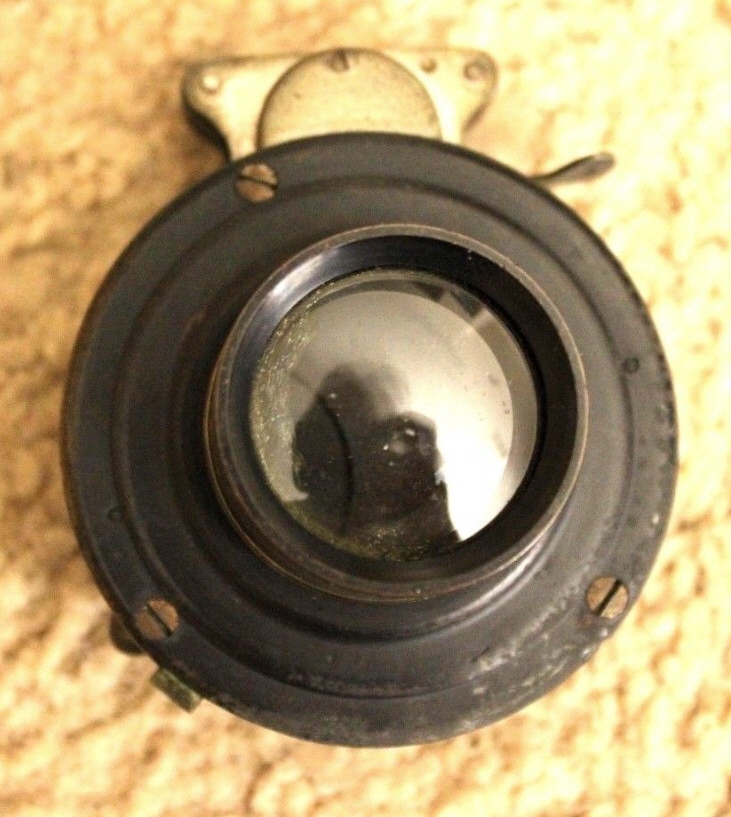
I have on order an 1890's-era camera lens as a project to adapt it to my Samsung NX1 digital camera for experimentation in photography and digital film.
I'm drawn to the subtle optical property differences of vintage lenses. I have been collecting 35-mm camera lenses from the mid 1950's through early 1990's and posting the photography taken with these various lenses on my blog here: http://mynx1.blogspot.com
This is my first 'antique' lens acquisition. I was looking for a lens over 100-years old being motivated as the result of a restoration I'm performing on a 1918 Silent Era film. Researching the early film history of that time has me focused on the cameras and projectors developed during the early years of film.
I decided on this particular lens after reviewing online auctions for lenses that to me had quality looking optics for its time and was enclosed in a housing 'mountable' to my bellows assembly. Also, I was looking for something to get my feet wet, adapting and mounting to my camera. My budget was less than a $100 for the lens and adapting hardware components.
I purchased this lens without learning any historical background of optics and lens-types at the turn of the 20th Century. Once the lens arrives, I will examine marking and do research on the company and the lens' application.
This Bausch & Lomb 'Victor' lens was manufactured at the Rochester Optical Co. somewhere between the late 1890's and early 1900's. The lens is a f8 with a two-blade return, rectilinear movement shutter-type. Spring powered, pneumatic exposure control. Speeds 1/100 - 1, B, T. Mounted between the lens. Finger and pneumatic release.
The lens was removed from a Pony Premo 4x5 plate camera of that era. More research is needed.
What attracts me to optical device is its attractive mechanical design; which will appears serviceable and well-built. I don't know at this time its operational condition. Also, I will have to figure-out how to keep the shutter open since the digital camera I will be using will have its own shutter activation.
I will post updates on this lens leading to revealing images that result. Should be interesting.
Wednesday, May 30, 2018
Second-pass Restoration of "Revenge of Dacota" Underway
Restoration continues on the 1918 release of "The Trail to Yesterday". Due to missing footage, the restoration will 're-incarnate' into the Dutch distributed release title: Revenge of Dacota.
The 'second-pass' restoration on the digital transfer format of the scanned film (.DPX), is focused on removing remaining artifacts left from the first pass of the restoration. In addition to artifact removal, frame stabilization, sizing each scene to 35mm film picture size (1:33); and setting the historical standard frame rate of 16-fps set in 1916 by the Society of Motion Picture Television Engineers® (SMPTE); is being accomplished.
DaVinci Resolve Studio tools for the restoration arrived on the scene at just the right time to accomplish this opportunity.
This second-pass restoration effort is frame-by-frame this time, as opposed to using algorithms (first-pass) to scan the files utilizing VivaPRO software.
* Panasonic Lumix DMC-FZ35 is 2009 camera/sensor technology
https://www.dpreview.com/products/panasonic/compacts/panasonic_dmcfz35
WWW.PSYCHOTROPICFILMS.COM
Wednesday, April 04, 2018
Phase II of "Dacota" Restoration Underway
Monday, November 13, 2017
"The Trail To Yesterday" 1918 (the reincarnation begins)
Tuesday, May 16, 2017
THE DOME wins 'Best of Arizona' at AIFF
Thursday, April 20, 2017
The DOME to Screen at AIFF, Tucson on April 23rd
The 26th annual 2017 Arizona International Film Festival in Tucson opened last night and will run through the end of the month. Here's a quick plug for the fest from KVOA News:
http://www.kvoa.com/clip/13262636/arizona-international-film-festival-starts-tonight
The news spot contains a few clips from THE DOME a collaboration between Taxman Films and Psychotropic Films, with will screen on April 23rd at 1:00pm, preceded by a panel discussion on the film at 11:00am
Films are shown at Screening Room, Congress Street. See website: www.filmfestivalarizona.com
Thursday, March 16, 2017
TaxMan Films Title Card
TaxMan Films Title Card from Psychotropic Films on Vimeo.
Monday, February 13, 2017
MZUNGU to Screen at the Arivaca Film Exhibition
Psychotropic Films is proud to announce the screening of MZUNGU - A Stranger's Dream in Africa at the Arivaca Independent Filmmakers Exhibition on Saturday March 4th at 12:45pm, as part of the program's afternoon documentary program.
Post-production for MZUNGU took 10-years to complete due to both the artistic and technical challenges inherent in the complexity of the production.
Bart Santello, MZUNGU's director says that the technical challenges stemmed from the fact that filming used a 2005-vintage Sony TRV-38 digital camera, recording onto Mini-DV tape (SD). The film also used a couple of consumer-based digital cameras at the time that only recorded in 480P!
So scaling-up the footage to look presentable on today's modern HDTV's (2K) was a considerable effort. Where the imaging was inadequate, the images were processed to create and artistic effect.
Psychotropic Films employs a 'sub-conscious' filmmaking process in which a film is created based inspired images based on an idea (concept). The film was assembled like a giant jigsaw puzzle of visual 'elements', over the years slowly revealing the experience of two months in Rwanda and Uganda - a memory of that experience. The result is a 'dream-like' imagery and sound experience, which provides the viewer an experience as if they have woken-up inside a dream.
New Video Editing Computer
Psychotropic Films has added a new high-performance Video Editing Computer to handle 4K footage from its Samsung NX1 Digital Camera. Primary editing software is Magix Vegas Pro 14 & Video ProX.
Built Specifications:
SYSTEM BUILDER: CyberPowerPC
CASE: Corsair Carbide 300R w/USB 3.0
CPU: Intel(R) Core™ Processor i7-6800K 6-Core 3.40GHz 15MB Intel Smart Cache LGA2011-V3
MOTHERBOARD: MSI X99A XPower Gaming Titanium, Wi-Fi 802.11 AC, USB 3.1 Type-C, Intel GbE LAN, 5x Gen3 PCIe x16, 1 PCIe x1, 2x M.2 PCIe9
PRIMARY DRIVE: M2SSD: 256GB Intel(R) SSD 600p Series PCIe NVMe M.2 SSD - 1800MB/s Read & 560MB/s Write
SSD: 480GB SanDisk Z410 SATA-III 6.0Gb/s SSD - 535MB/s Read and 445MB/s Write
VIDEO CARD: ASUS GeForce(R) GTX 1070 Dual-Fan OC Edition 8GB GDDR5 (Pascal)
MEMORY: 16GB (4GBx4) DDR4/3000MHz Quad Channel Memory (Corsair Vengeance)
NETWORK: Onboard Gigabit LAN Network & built-Wifi Dual band
SOUND: High Definition On-Board 7.1 Audio
OPTICAL: LG BluRay 16x Reader/Writer w/M-DISC support
POWERSUPPLY: 800 Watts - Certified Power Supply
FAN: Cooler Master Hyper 212 LED CPU Cooler w/ PWM fan Plus 3X 120mm Case Fans
USB HUB: Internal USB 3.0 4-Port Hub
FLASHMEDIA: INTERNAL 12in1 Flash Media Reader/Writer
OS: Windows 10 Home (64-bit Edition)
Thursday, September 29, 2016
Boosting Field Recorded Audio
I was out at 4 am a few weeks back recording coyotes in the outback here in Arizona. The recording on my Edirol R09 at 24-bit/48-kHz was good, but the recording level was very low at -39dB. I couldn't get the volume level anywhere near my target of -12dB in my DAW, so in order to boost the signal boosted I went with a hardware solution.
So I ran a line-out from the Edirol R09 to a Rolls Promatch MB15b, which converts consumer stereo level signals to professional line level signals and provide audio amplification. Then to further amplify the signal, the output from Rolls Promatch was directed to a Behringer U-PHORIA UM2 2x2 USB Audio Interface. The UM2 has a preamplifier and dedicated output level control.
The output of the UM2 was send via USB to my computer and imported using Magix's Audio & Music Laboratory. I was able to achieve the volume increase, but I was somewhat disappointed in the signal-to-noise ratio. However, the next step will be to filter out the noise and then work to create sound-design with the coyote yelps.
Saturday, September 24, 2016
MZUNGU's Last Edit?
For MZUNGU, my goal on the technical side was to develop 480P digital video and mini-DV tape (mid-2005 consumer imaging technology) in order to express its full potential from that era - while at the same time scaling-up the image to current HDTV technology. Coincidentally, this type of vintage footage was ideally suited for artistic expression to convey a perception what I experienced in Africa. These textured images invoke dreamlike environments that mirror stages of sleep and consciousness.
Tuesday, September 20, 2016
THE DOME
Thursday, April 21, 2016
ROAD STORM Screening in Tucson
Saturday, December 26, 2015
Road Storm submitted to the Arizona International Film Festival (April, 2016)
Related: Arivaca Film Exhibition
Thursday, November 12, 2015
Photographs from WASTELANDER
All photos by Bart Santello
Taken at the Tucson Convention Center
November 8. 2015
2015 Psychotropic FilmsTM